
Portfolio Lead: Dr Anelisa Jaca (anelisa.jaca@mrc.ac.za)
LinkedIn Profile: https://www.linkedin.com/in/anelisa-jaca-b201a040/
Health Inequality Monitoring (HIM) measures and explains avoidable and unjust differences in health outcomes and access to healthcare services across population groups. HIM enables countries to identify who is being left behind, understand the drivers and patterns of inequality, and inform targeted actions to improve health equity and achieve better health outcomes for all.
The HIMEA research portfolio focuses on strengthening the generation, analysis, and use of equity-focused evidence to support health-system research, policy, and decision-making in South Africa and beyond.
HIM in practice: monitoring immunization inequalities
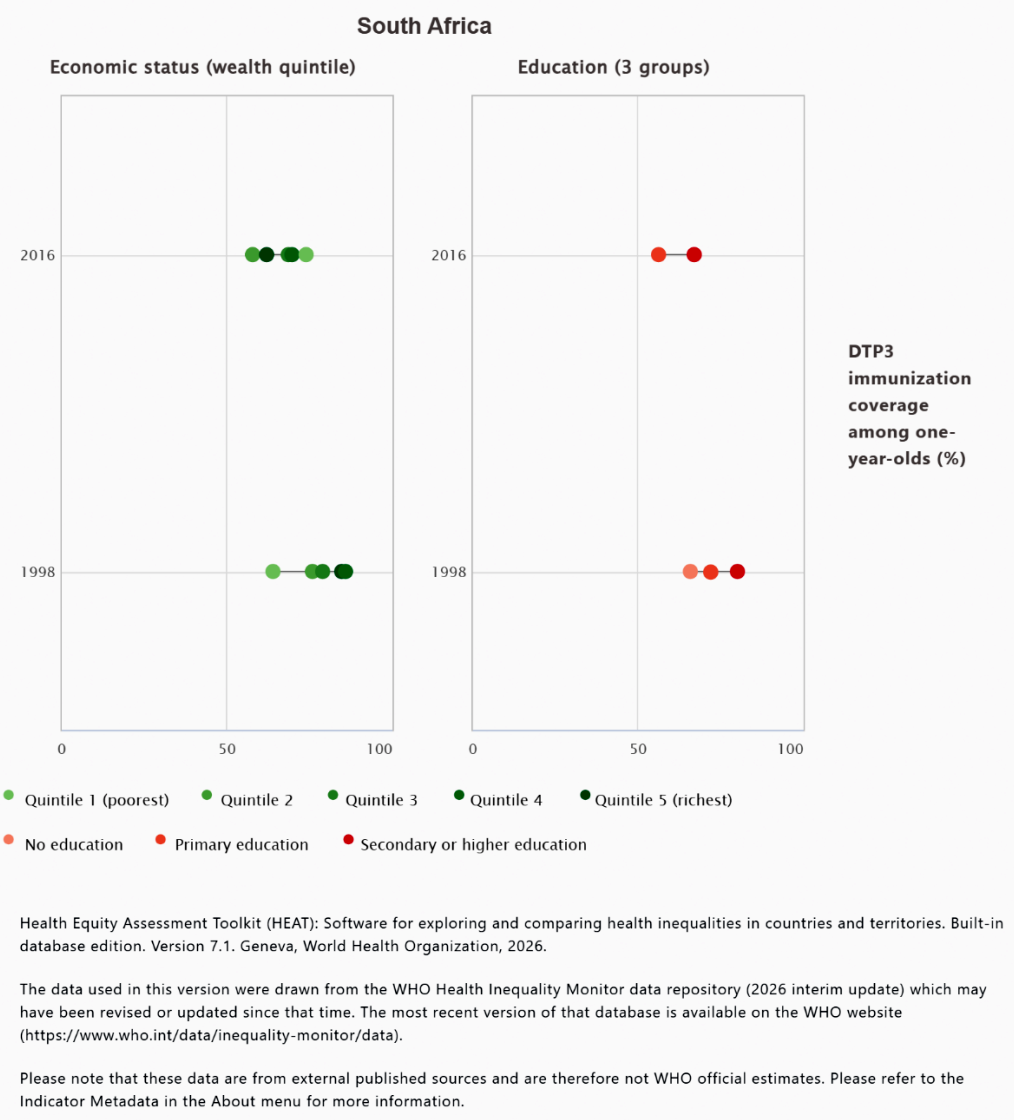
The figure illustrates how health inequality monitoring can reveal differences in DTP3 immunization coverage across socioeconomic and educational groups (Figure 1). Overall, coverage was relatively high, but differences between population groups were evident in both periods. In 2016, coverage across wealth groups was more closely clustered than in 1998, while differences by education level remained noticeable. These patterns demonstrate how disaggregated data can identify population groups experiencing lower coverage and help guide more equity-focused immunization planning and action.
Research focus areas
The HIM research portfolio is structured around three complementary areas:
The portfolio aims to strengthen the generation and use of health inequality evidence within the South African health information system, with a focus on monitoring inequalities and inequities across priority health areas.
A current project focuses on institutionalizing HIM within the South African health system, using childhood immunization as a proof of concept. The project uses disaggregated health data and inequality measures to identify disadvantaged populations and generate evidence to inform equity-oriented policy and program action.
The portfolio develops and applies approaches that strengthen the translation of health inequality evidence into policy and decision-making.
A current project integrates Health Inequality Monitoring, health policy analysis and public health informatics to facilitate the uptake and use of equity data and strengthen the application of an equity lens in health-system decision-making. The work seeks to establish a pathway from data generation and inequality measurement, through interpretation and policy analysis, to knowledge translation and decision support.
The portfolio also focuses on strengthening capacity in Health Inequality Monitoring methods among Member States, researchers, policymakers, and other stakeholders.
Current and planned activities include:
- Science for Africa Foundation policymakers’ workshop: A three-day practical workshop on the HIM cycle, with a focus on using data for policymaking and data visualization. Addis Ababa, Ethiopia, 19–21 November 2026.
- Cochrane Colloquium 2026 workshop: Measuring health inequities in zero-dose children in the South African context, using the WHO HIM methodology. Kraków, Poland, 8–10 December 2026.
These activities aim to build practical skills in generating, analyzing, interpreting, visualizing, and communicating health inequality evidence for policy and decision-making.
Resources related to the work
- Jaca A, Mathebula L. Integrating Health Inequality Monitoring and Equity-Focused Policy Analysis for Immunization: A Conceptual Framework for Translating Data into Equity-Oriented Action. Vaccines. 2026;14(3):219. https://doi.org/10.3390/vaccines14030219
- Jaca A,Malinga T, Iwu-Jaja CJ, Nnaji CA, Okeibunor JC, Kamuya D, Wiysonge CS. Strengthening the Health System as a Strategy to Achieving Universal Health Coverage in Underprivileged Communities in Africa: A Scoping Review. International Journal of Environmental Research and Public Health. 2022;19(1):587. https://doi.org/10.3390/ijerph19010587
- Jaca A,Iwu-Jaja C. Research gaps on Universal Health Coverage in the South African context and other low- and middle-income countries; putting things into perspective: a scoping review. BMC Health Services Research. Accepted for publication.
- Jaca A, Mathebula L. From data to policy: integrating health inequality monitoring and equity-focused policy analysis for immunization decision-making. 20th Vaccine Congress, Seville, Spain, 13–16 September 2026.
- Jaca A, Mathebula L. Strengthening capacity for health inequality monitoring in South Africa: building skills across the HIM cycle. 20th Vaccine Congress, Seville, Spain, 13–16 September 2026.
- Jaca A, Mathebula L. Measuring health inequities in zero-dose children in the South African context, using the WHO Health Inequality Monitoring methodology. Cochrane Colloquium 2026, Kraków, Poland, 8–10 December 2026.
- Jaca A, Mathebula L. Institutionalizing health inequality monitoring for immunization in South Africa: a proof-of-concept using disaggregated EPI Survey data. 5th Africa CDC CPHIA 2026, Addis Ababa, Ethiopia, November 2026.
Collaborations and Networks
The HIMEA research portfolio is affiliated with the WHO HIM Network, coordinated by the World Health Organization. The Network brings together institutions and technical partners committed to advancing health inequality monitoring globally and strengthening the use of equity-focused evidence to inform policy and decision-making.
Through this affiliation, the portfolio advances HIM through equity-focused evidence generation and synthesis, methodological innovation, training and capacity strengthening, and collaborative technical support initiatives.
PHIDA contributes informatics expertise to the Health Inequality Monitoring portfolio through data management, analytics, equity dashboards, and visualization. It supports the development of accessible decision support tools that translate inequality findings into evidence for policy analysis and program planning.
The portfolio collaborates with the Department of Public Health and Nursing at the Norwegian University of Science and Technology (NTNU) on complementary research examining how health inequality monitoring data are translated into government policies.
The portfolio also collaborates with the Science for Africa Foundation (SFA) to strengthen the capacity of policymakers and researchers to use equity-focused evidence and evidence-based research in health policy and decision-making.
Looking ahead
Through research, methodological development, capacity strengthening and collaboration, the HIMEA portfolio aims to contribute to the institutionalization of HIM in South Africa and to strengthen the routine use of equity evidence in health-system policy and decision-making.
The longer-term vision is to move beyond measuring inequalities towards ensuring that equity evidence is translated into action to improve health outcomes for populations experiencing disadvantage.