
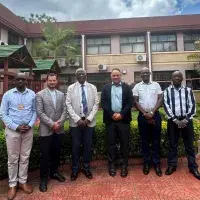
Cochrane South Africa’s (CSA) Prof Mark Engel and Ameer Hohlfeld undertook a visit to the University of Zambia’s School of Medicine from 24-27 March 2026. This was in alignment with Cochrane’s broader mission to support the production, use, and accessibility of high-quality evidence. It aimed at strengthening partnerships with Southern African hubs and research networks towards advancing collaborative approaches to evidence- informed healthcare across the region.
In welcoming the Cochrane team, Prof. Evans Mpabalwani, Dean of the School of Medicine at the University of Zambia, underscored the strategic importance of the visit for advancing evidencebased healthcare in resource-constrained settings. He highlighted systematic reviews as a cornerstone of informed clinical and public health decision-making, noting their particular relevance in contexts where efficiency, impact, and cost-effectiveness are essential. The Dean further emphasised the value of collaboration, skills transfer, and partnership building in empowering postgraduate researchers and faculty, describing the engagement as a foundation for sustained institutional collaboration and improved patient outcomes.
A central feature of CSA’s participation included activities focused on systematic reviews and evidencebased methods. The core training elements involved: formulating answerable questions, developing questions using mnemonics, targeted literature searching using the Cochrane Library and PubMed, critical appraisal, data extraction and synthesis. The focus was on moving from workshop learning into a publication-oriented workflow.
Discussions also focused on the role of regional hubs and networks in ensuring that evidence generation and synthesis are responsive to Southern African health priorities and offered an opportunity to establish regional collaboration, build sustainable research capacity, and align priorities across institutions working in evidence synthesis and health systems strengthening.
Ameer Hohlfeld said, “Building evidence-based healthcare capacity in the region requires more than technical training alone. It depends on sustained partnerships, shared learning, and creating practical opportunities for clinicians, researchers, and postgraduate students to apply evidence synthesis methods to the health priorities that matter most in our context. This visit was an important step towards strengthening those regional connections and supporting a more responsive evidence ecosystem in Southern Africa.”
This engagement reinforces CSA’s commitment to working collaboratively across borders to strengthen evidence ecosystems, support emerging researchers, and ensure that high‑quality evidence is produced with and for the region—advancing Cochrane’s purpose of improving health outcomes through trusted evidence.