
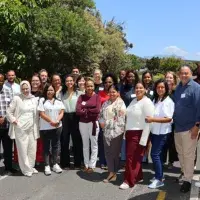
Cochrane South Africa (CSA) recently hosted a three-day Evidence-to-Decision (E2D) Protocol Development Workshop, aimed at strengthening national capacity for evidence-informed decision-making within the South African health sector, taking place at the South African Medical Research Council’s (SAMRC) Conference Centre from 18-20 February 2026.
The E2D project is a Department of Health-funded initiative in partnership with the SAMRC’s Health System Research Unit, Cochrane South Africa and Stellenbosch University’s Centre for Evidence-Based Health Care. The workshop formed part of the work of the E2D Goal 3 Training Working Group, which focuses on building the skills of both evidence producers and users who contribute to evidence-informed decision-making (EIDM) and improved healthcare outcomes in the public health system.
The training was facilitated by CSA’s Unit Director Prof Mark Engel and Senior Scientist Ameer Hohlfeld, who guided participants through a structured, hands-on learning process over the three days. Participants included Dr Janine Jugathpal, Deputy Director: Essential Drugs Programme (EDP) and members of the EDP Oversight Group of the Affordable Medicines Directorate, National Department of Health. The EDP Oversight Group is responsible for the review and updating of the National Standard Treatment Guidelines and Essential Medicines List and oversees the work of the ministerially appointed National Essential Medicines List Committee (NEMLC) and Expert Review Committee of the NEMLC.
Workshop goals
The primary goal of the workshop was to strengthen participants’ capacity to develop high-quality, methodologically sound protocols for evidence synthesis, aligned with the needs of decision-makers in the South African National Health Sector. Specifically, the workshop aimed to:
Improve understanding of evidence-based health care (EBHC) principles,
Support participants to translate real-world health problems into well-framed research questions,
Build practical skills in protocol development, from question formulation to synthesis and grading of evidence.
Programme activities and highlights
The three-day workshop combined short lectures with highly interactive and practical learning activities, enabling participants to apply concepts directly to their own topics.
Day 1 focused on laying the foundations of evidence-based health care and protocol development. Participants explored what makes EBHC distinctive, worked in groups to turn health system problems into structured research questions, and refined these questions through guided exercises. Interactive activities included outcomes prioritisation using a “fishbowl” approach, structured work on protocol rationale and objectives, and group reflections at the end of the day.
Day 2 shifted towards the technical components of evidence synthesis protocols. Sessions covered eligibility criteria, data management, and the development of reproducible search strategies. Participants engaged in hands-on searching exercises, learned about article management using Rayyan software, and were introduced to the Risk of Bias 2.0 tool through guided practice. The day concluded with dedicated time for group protocol development and reflection.
Day 3 addressed the later stages of the evidence synthesis process. Practical exercises focused on data extraction, synthesis essentials, handling heterogeneity, and applying the GRADE approach to develop Summary of Findings tables. The workshop concluded with final reflections and feedback from participants.
Reflections from partners and facilitators
Dr Jugathpal said, “We welcome the opportunity to strengthen capacity development through Cochrane SA, our partner in the Evidence to Decision Collaboration, thereby investing in the knowledge and skills required to ensure that the best available research evidence informs our national health policy and healthcare guidance”.
“We consider it a privilege to be working closely with our colleagues from the Department of Health, in contributing to capacity strengthening for evidence-informed decision-making,” added Prof Engel.
Strengthening evidence-informed decision-making
By combining methodological rigour with practical, applied learning, the E2D Protocol Development Workshop contributed to strengthening the link between evidence generation and decision-making in South Africa’s health system. The workshop also reinforced Cochrane South Africa’s ongoing commitment to supporting high-quality evidence synthesis that responds to national health priorities.