
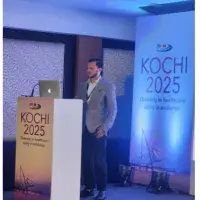
Ameer Hohlfeld, a Senior Scientist at Cochrane South Africa attended the JBI Global Evidence Conference in Kochi, India from 19-21 November 2025. The JBI Global Evidence Conference is a major international gathering focused on evidence synthesis, evidence implementation, and Knowledge Translation (KT) and brings together guideline developers, policymakers, researchers, clinicians, and KT practitioners who collectively influence how high-quality evidence is produced and used throughout health systems. The event is central to global efforts aimed at reducing research waste, improving evidence standards, and ensuring that decisions are informed by the full body of available evidence.
“I presented two papers on publication bias. My aim was to contribute to global discussions on reducing research waste in evidence synthesis and clinical trials, while engaging with experts working to strengthen transparency, methodology, and knowledge translation. The conference provided an important platform to share our work and learn from international leaders advancing more trustworthy and accessible evidence practices”, said Hohlfeld.
This year’s conference highlighted several critical topics and the themes which included: reducing bias, improving transparency across the research pipeline, and strengthening the systematic use of evidence in decision-making. Sessions on guideline development emphasised rigorous evidence synthesis, meaningful stakeholder engagement, and prioritising relevant research questions to avoid unnecessary duplication. The programme also showcased practical tools and methods, including the GRADE approach and strategies for adapting and contextualising guidelines for diverse settings. Innovations in KT—such as infographics and storyboarding—were presented as effective ways to make evidence more accessible to clinicians, policymakers, and communities.
A major strength of the conference was the diversity of attendees. Participants included global leaders from JBI, evidence-synthesis specialists, clinicians, policymakers, journal editors, implementation scientists, and researchers at various career stages. Delegates came from Australia, Austria, South Africa, Italy, the Czech Republic, India, Bangladesh, the United Kingdom, Canada, the United States, Japan, Kenya, Malaysia, Nigeria, and many other countries across Europe, Asia, and Africa. This mix ensured rich discussions on how different health systems adapt evidence methods to their local contexts, especially in low- and middle-income countries. Outcomes of the meeting will inform several future directions, such as strengthening capacity-building activities, expanding training opportunities, and integrating new KT tools—such as infographics—into our departmental strategy. Lessons learned will also feed directly into efforts to improve transparency and prevent research waste. There is also interest in developing mentorship pathways, building toolkits for KT and implementation, and exploring sustainable funding models to allow wider access to evidence-based practice training.
“Presenting in Kochi was energising and meaningful. Engaging with global experts deepened my understanding of research waste, publication bias, and KT, while affirming the importance of collaborative, transparent methods. The conference strengthened my commitment to advancing ethical, high-quality research and expanded my network of colleagues working to improve the impact of evidence across health systems”, concluded Hohlfeld.